
What Does the PSAT Math Section Test?
The PSAT/NMSQT (Preliminary SAT/National Merit Scholarship Qualifying Test) Math section measures a student’s ability to solve mathematical problems, reason quantitatively, interpret data, and apply mathematical concepts to real-world situations.
The current digital PSAT Math section focuses on four major content areas: Algebra, Advanced Math, Problem-Solving and Data Analysis, and Geometry and Trigonometry.
Questions range from straightforward calculations to more challenging, multistep problems that require students to analyze information, choose an appropriate strategy, and apply mathematical reasoning.

TESTINGMOM The Trusted Leader in Gifted Test Prep
- 1M+ families helped
- 15+ years supporting test prep families
- Created by Karen Quinn, The Testing Mom, the foremost expert on gifted tests

PSAT Math Section Quick Facts
| Feature | Digital PSAT/NMSQT Math |
|---|---|
| Total Questions | 44 |
| Total Time | 70 minutes |
| Modules | Two modules, 35 minutes each |
| Question Types | Multiple-choice and student-produced response |
| Calculator Use | Permitted throughout the Math section |
| Test Format | Digital and adaptive by module |
| Content Areas | Four Math domains |
The PSAT Math section is adaptive by module. Students complete the first module, which contains questions of varying difficulty. Their performance helps determine the difficulty level of the second module.
Students may use the built-in calculator provided through the Bluebook testing application or an approved calculator throughout the Math section.
What Math Skills Are Tested on the PSAT?
1. Algebra
Algebra questions focus on linear equations, inequalities, functions, and systems of equations.
Students must understand how to represent mathematical relationships and solve problems involving unknown quantities.
Skills assessed include:
- Solving linear equations in one variable
- Solving linear equations in two variables
- Understanding linear functions
- Solving systems of two linear equations
- Solving linear inequalities
- Interpreting graphs, tables, and equations
- Applying linear relationships to word problems
For example, students might be asked to find the value of an unknown variable, interpret a line’s slope, or solve a system of equations that represents a real-world situation.
2. Advanced Math
Advanced Math questions assess students’ understanding of more complex algebraic expressions, equations, and nonlinear functions.
These questions often require students to recognize mathematical relationships and select efficient problem-solving methods.
Skills assessed include:
- Working with equivalent algebraic expressions
- Solving quadratic equations
- Factoring polynomial expressions
- Understanding exponential functions
- Solving nonlinear equations
- Working with radical and rational expressions
- Interpreting nonlinear graphs
- Connecting equations to their graphical representations
For example, students may need to solve a quadratic equation, identify an equivalent expression, or determine how changes in an equation affect its graph.
3. Problem-Solving and Data Analysis
This content area focuses on applying mathematical reasoning to practical situations and interpreting information presented in tables, graphs, and other data displays.
Skills assessed include:
- Ratios, rates, and proportional relationships
- Percentages and percent change
- Measurement units and conversions
- Analyzing data distributions
- Measures of center and spread
- Interpreting scatterplots
- Understanding linear models
- Probability and conditional probability
- Making inferences from data
For example, a student might calculate a percentage increase, interpret a graph showing population changes, or use statistical information to support a conclusion.
These questions measure how well students can use mathematical information to solve problems and make decisions.
4. Geometry and Trigonometry
Geometry and Trigonometry questions assess students’ understanding of shapes, measurements, angles, and spatial relationships.
Skills assessed include:
- Calculating area and volume
- Understanding lines and angles
- Working with triangles
- Applying the Pythagorean theorem
- Understanding congruence and similarity
- Solving right-triangle problems
- Using sine, cosine, and tangent ratios
For example, students may need to determine a missing side length in a right triangle, calculate the volume of a three-dimensional figure, or apply geometric relationships to solve a problem.
Important: Although the PSAT and SAT share many mathematical topics, they are not identical. The SAT includes additional circle-related Geometry content that is not part of the PSAT/NMSQT’s tested Math skill categories.
How Difficult Is the PSAT Math Section?
PSAT Math questions range from easier problems that assess foundational skills to more challenging questions requiring multiple steps and deeper reasoning.
Some questions can be solved by applying a familiar formula or mathematical rule. Others require students to interpret information, connect multiple concepts, or determine the most efficient strategy.
Because the PSAT is adaptive by module, students may encounter different difficulty levels in the second module based on their performance in the first.
How Should Students Prepare for PSAT Math?
Effective preparation starts with understanding the mathematical concepts tested and identifying skills that need improvement.
Students should:
- Review foundational Algebra skills. Strong algebra skills are essential for success throughout the Math section.
- Practice multistep word problems. Learn to identify relevant information, select appropriate operations, and check whether an answer makes sense.
- Become comfortable with graphs and tables. Practice interpreting mathematical relationships and drawing conclusions from data.
- Review formulas and geometric relationships. Understand how to apply formulas rather than simply memorizing them.
- Practice using a calculator efficiently. Learn when a calculator is helpful and when mental math or algebraic reasoning is faster.
- Work with digital PSAT-style questions. Become familiar with both multiple-choice and student-produced response formats.
- Review incorrect answers. Understanding why you made a mistake is one of the most effective ways to strengthen your mathematical reasoning.
Want to try us out? Sign up for a free account today and get 100 practice questions.
PSAT Math Sample Questions:
Sample Question #1
Which of the following is equivalent to the expression below?
7a + 6b – 5a – (4b + 3a – 2b)
- -a
- -a + 4b
- a + 4b
- 5a + 4b
Answer: B – Combine like terms and distribute the negative: (7a – 5a – 3a) + (6b – 4b + 2b) = -a + 4b
Sample Question #2
(4 x 10⁵)(5 x 10⁴) is equivalent to which of the following?
- 0.2 x 10⁹
- 2 x 10⁹
- 9 x 10⁹
- 2 x 10¹⁰
Answer: D – (4 x 5) x (105 x 104) = 20 x 105+4 = 20 x 109 = 2 x 10¹⁰
Sample Question #3
If a square has 3 vertices at (0, 3), (3, 6), and (3, 0), what could be the coordinates of the 4th vertex?
- (0, 6)
- (3, -3)
- (6, 3)
- (6, 6)
Answer: C – The 4th coordinate of the square is (6, 3).
Sample Question #4
If the product of 3 consecutive integers is 60, which of the following equations can be used to determine the integers?
- x3 + 3x = 60
- x3 + 2x2 + 2x = 60
- x3 + 3x2 + 2x = 60
- x3 + 3x2 + 3x = 60
Answer: C – 1st integer = x, 2nd integer = x + 1, 3rd integer = x + 2; x(x+1)(x+2) = 60, x(x2+3x+2) = 60, x3 + 3x2 + 2x = 60
Sample Question #5
Triangle BCD is shown below:
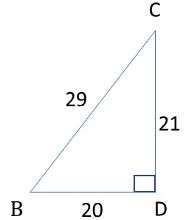
What is cos B ?
- 0.689
- 0.724
- 0.952
- 1.45
Answer: A – CosB = adjacent/hypotenuse, CosB = 20/29, CosB = 0.689
Sample Question #6
Phoenix is a freelance Math Writer. If she is paid $500 for every 50 math problems that she writes, how many math problems must she write to earn $4900?
- 410
- 480
- 490
- 4900
Answer: C – $500/50 = $10 per math problem, let x = number of math problems, 10x = $4900, x = 490; Phoenix must write 490 math problems to earn $4900.
Sample Question #7
What is the area of the figure below, given that all angles are 90?
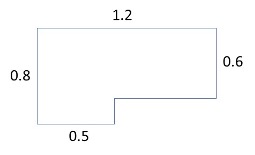
- 0.82 un2
- 0.94 un2
- 8.2 un2
- 9.4 un2
Answer: A – Divide the figure into two rectangles and multiply their L x W. Rectangle A is 0.8 x 0.5 = 0.4. Rectangle B is 0.6 x (1.2 – 0.5) = 0.42. Total area of the figure is Rectangle A + Rectangle B = 0.4 + 0.42 = 0.82 un2.
Sample Question #8
On Monday, Johnny bought Coca-Cola stock for $54/share. On Tuesday, the price increased by 5%, and on Wednesday, the price decreased by 2%. What was the stock price at the end of Wednesday?
- $54.57
- $55.57
- $56.57
- $56.70
Answer: B – Stock was purchased at $54 per share. Tuesday the price increased 5% = $54 x 1.05 = $56.70, Wednesday the price decreased by 2% = $56.70 x 0.98 = $55.57.
Want to try us out? Sign up for a free account today and get 100 practice questions.
See if TestingMom.com supports your child’s test by your school district. If you don't see your child's school district listed, check with us! We have practice for other tests as well.
Tell us about your experiences