


Did you know there is a connection between high IQs and the ability to lie well?
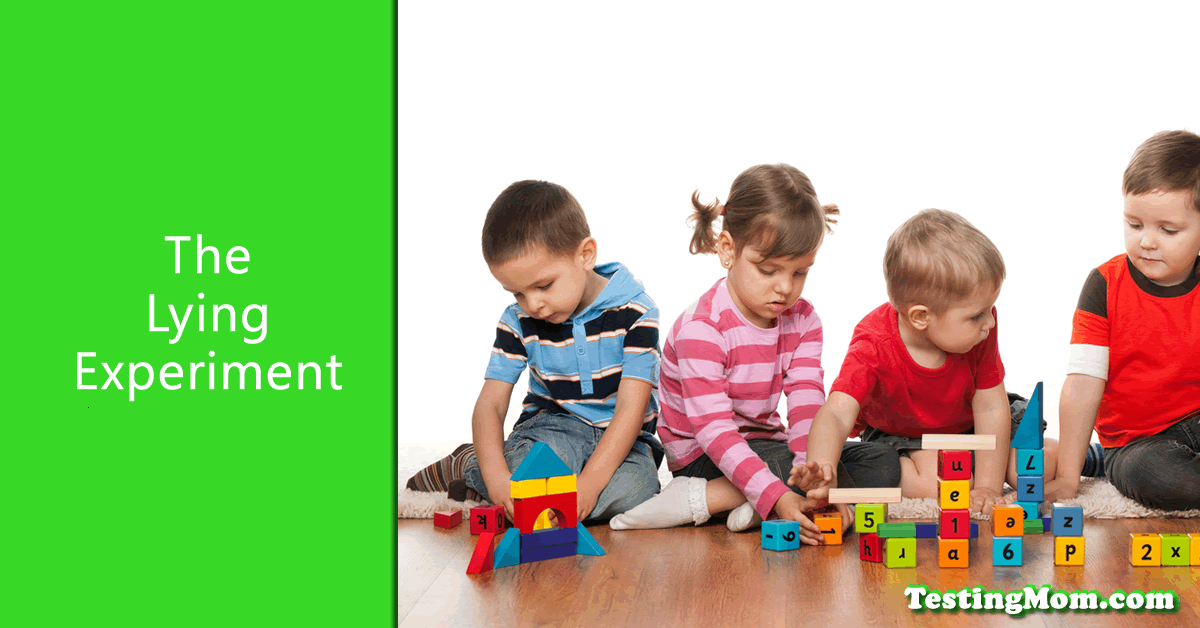
We want to instill in them a desire to be truth tellers, of course. But it is something you can do and watch for in your highly intelligent children.
Read the lying experiment we tried and see if that is a proclivity of your child.
We know that in young kids, lying is certainly related to cognitive development. We often see lying in children who are developing cognitively early. There is also the connection in adults between high IQs and the ability to lie well. This is related to pathology as well as the spectrum of lying. We do know that, in young children, lying is related to early intelligence.
First: Catch Your Child Unprepared
To be able to study lying, you have to see someone lie. This becomes tricky because that is normally concealed behavior. If I ask you to lie now, I know that you’re lying to me, and you know that I know you’re lying, and it’s not the same. We have to create situations where children may choose to lie.
Second: Determine Your Child’s Lying Patterns
A game is one way we can determine a child’s lying patterns. The game starts with the child hearing the sounds of different toys that are behind their back. They have to guess what it is. We make sure they’re all ones that make characteristic sounds, so Elmo, for instance, says a few things, and they can guess what it is. We have a few of these toys, and they enjoy the game of guessing what they are.
Third: Leave the Room and See What Happens
For the last one, we say, “I have to go out of the room for a moment because I left papers in the other room. I’m going to leave the toy on the table, and I’m going to play the clue, and you listen. When I get back, you can guess what it is.” We leave the room for a minute, and a hidden video camera captures their behavior. What we find is that for the vast majority of young children this is really tempting. They really want to know what it is.
We make sure the clue in this case is not associated with the toy. It’s from a greeting card, so there’s no way, based on listening to the clue, that they can guess what it is. We find that the majority of children ages 3 to 7 will turn around and look at the toy because they’re very curious to know what it is. We even get some children who pick up the toy and play with it a little. When they hear us coming back into the room, they put it back and turn around so their backs are to the toy because we’ve told them they’re not allowed to look at it while we’re gone.
Fourth: The Reveal!
We usually cover the toy next. We ask the child to turn around and face us, and we ask them if they’ve peeked at the toy when we’re gone. What we find is that many children will deny that they have peeked and say, “No,” that they haven’t peeked. With more children, as they get older, they’re more likely to tell a lie. For instance, three-year-olds are more likely to confess and say, “Yes,” that they have peeked. But we also find that they’re not very good at lying.
We ask them what they think the toy is, and they often blurt out answers that are cues to their deceit. For instance, in one case, the toy that we had was a plush soccer ball. We said, “What do you think it is?” The child said, “It’s black and white.” We said, “How do you know it’s black and white?” The child froze suddenly and couldn’t answer that.
As they get older, children become more creative in their answers. We had an older child in the same situation with the plush soccer ball say, “Well, I’ve heard that squeaking sound before when I’ve played at the gym. I think based on the sound, it’s a soccer ball.” The music that we were playing was I think a greeting card that was playing Wagner’s Walkure, so it had nothing to do with it. But the child was trying to come up with a plausible explanation about why he was going to guess it was the soccer ball!
The experiment is quite telling! But it will also give you the keys you need to train your highly intelligent child in the value and importance of telling the truth and integrity. It is the gift of parenting — to teach and train them for their wonderful futures!




Tell us about your experiences
2 Responses
Hm… Maybe I should do this experiment with my 6y old daughter! Where do you get video cameras?
-CS
Ah, this is interesting!