
i-Ready 3rd Grade Practice Questions & Test Prep
Choose a ProgramThe i-Ready Diagnostic, now called i-Ready Inform™ for Reading and Mathematics, is an adaptive online assessment that helps teachers understand your child’s current reading and math skills and determine what they’re ready to learn next.
Because the assessment is adaptive, question difficulty changes based on your child’s responses. When your child demonstrates that they understand a skill, they may receive more challenging questions. If they struggle, the assessment may adjust to better identify the skills they’ve already mastered and those that still need development.
That means your third grader may see questions covering material they haven’t learned in school yet.
That’s normal.
Your child isn’t expected to know every answer. In fact, encountering difficult questions is part of how an adaptive assessment determines the upper range of your child’s current skills.
Here are some of the Reading and Mathematics skills a third grader may encounter.
Math
Algebra and Algebraic Thinking – Third graders develop a stronger understanding of multiplication and division, patterns, relationships, and unknown quantities. They may solve equations with missing numbers, identify patterns, use properties of operations, and solve one- and two-step word problems.
Numbers and Operations – Students work with place value, addition, subtraction, multiplication, division, and fractions. Questions may assess a child’s ability to compare and order numbers, perform calculations, understand multiplication and division relationships, and recognize fractions as numbers.
Geometry – Students identify, classify, and compare shapes based on their attributes. They may work with quadrilaterals, recognize shared properties among shapes, divide shapes into equal parts, and reason about geometric relationships.
Measurement and Data – Students apply measurement concepts and interpret information presented in tables, graphs, and other data displays. Third-grade skills may include telling and calculating elapsed time, measuring length, working with mass and volume, interpreting scaled graphs, and solving measurement and data problems.

TESTINGMOM The Trusted Leader in Gifted Test Prep
Join the 1 Million+ families who we have helped over the last 15 years.
Reading
By third grade, reading instruction increasingly shifts from simply learning how to read toward using reading to understand increasingly complex information and ideas.
However, because i-Ready is adaptive, some children may also receive questions targeting earlier foundational reading skills when the assessment needs additional information about their decoding or word-reading abilities.
Vocabulary – Students demonstrate their understanding of words, their meanings, and how they’re used in context. Questions may ask children to use context clues, word relationships, prefixes, suffixes, roots, or other clues to determine the meaning of unfamiliar words.
Comprehension: Literature – Students read literary texts such as stories, poems, and other fiction and demonstrate their understanding of what they’ve read. Skills may include identifying the central message or lesson, describing characters and their motivations, understanding sequence and cause and effect, making inferences, and supporting answers with details from the text.
Comprehension: Informational Text – Students read nonfiction and informational texts and answer questions about the information presented. They may identify the main idea and supporting details, determine relationships among ideas or events, use text features, interpret information, determine word meaning in context, and identify an author’s point of view or purpose.
Phonics and Word-Reading Skills – If a student’s responses indicate a need for more information about foundational reading skills, the adaptive assessment may include questions involving phonics and decoding. These can help determine whether difficulties with more advanced reading tasks are connected to underlying word-reading skills.
High-Frequency Words – Some students may also encounter questions that require recognizing frequently used words if the assessment needs additional information about foundational reading development.
What Should My 3rd Grader Practice for i-Ready?
For third graders, preparation should focus on building strong grade-level Reading and Mathematics skills rather than trying to predict the exact questions your child will receive.
For Reading, practice:
- Reading both fiction and nonfiction
- Identifying main ideas and supporting details
- Making inferences
- Summarizing what was read
- Understanding characters, events, and themes
- Using context clues to determine word meaning
- Vocabulary
- Prefixes, suffixes, and word parts
- Finding evidence in a passage to support an answer
For Math, practice:
- Place value
- Addition and subtraction
- Multiplication and division
- Fact fluency
- Fractions
- One- and two-step word problems
- Measurement
- Time
- Graphs and data
- Geometry
- Mathematical patterns and relationships
Third grade is also a good time to work on multi-step thinking. Instead of asking only, “What’s the answer?” ask your child:
“How did you figure that out?”
Reasoning through a problem becomes increasingly important as academic work grows more complex.
Why Is My Child Getting Questions That Look Too Hard?
This is one of the most important things to explain before your child takes i-Ready.
Your child may encounter a question and think:
“We haven’t learned this yet!”
That’s okay.
The assessment adapts to your child’s performance and tries to determine what your child knows and what they’re ready to learn next.
Tell your child:
“Some questions may be easy, some may be just right, and some may be really hard. You’re not supposed to know everything. Think carefully, choose the best answer you can, and keep going.”
That little conversation can make a big difference.
A difficult question doesn’t necessarily mean your child is doing poorly.
And an easy question doesn’t necessarily mean your child is doing poorly either.
The best thing your child can do is work carefully, try every question, and not worry about whether the test seems easy or hard.
Practice i-Ready-Style Questions
TestingMom’s i-Ready-style practice can help third graders strengthen the Reading and Mathematics skills they may encounter and become more comfortable working through unfamiliar questions.
The goal isn’t to memorize questions or predict exactly what will appear on the assessment. Because i-Ready is adaptive, children can receive different questions based on their individual responses.
Instead, good preparation helps your child build the underlying skills, practice problem-solving strategies, and develop the confidence to keep working when a question becomes challenging.
That kind of test preparation carries over long after test day.
Below are sample questions representative of the 3rd-grade questions your child will see on the test, but they are not taken directly from this year’s i-Ready.
1. Where would you find the best information for a report about Chinese architecture?
A. your teacher
B. a dictionary
C. a person who lived in China with his family for three years
D. a television documentary about Chinese buildings and architecture
Answer: D
Read the following:
Mary had a little lamb,
Whose fleece was white as snow,
And everywhere that Mary went,
The lamb was sure to go.
2. What kind of writing is this?
A. poetry
B. non-fiction
C. fiction
D. fairy tale
Answer: A
3. Which statement is a fact, not an opinion?
A. Roxanne is a happy child.
B. Roxanne kept a daily diary.
C. Roxanne is a good friend.
D. Roxanne’s handwriting is very sloppy.
Answer: B
4. Solve for y. y = 3 x (9-4)
A. 23
B. 25
C. 15
D. 17
Answer: C
5. On the coordinate grid below, which is closer to home: the store, the library, or the school?

A. The library
B. The store
C. The school
D. The store and library are equally close
Answer: A
6. Give the possible values for y in the given function:
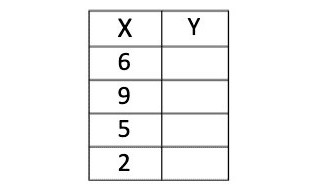
A. 8, 11, 7, 5
B. 4, 7, 3, 0
C. 4, 7, 0, 2
D. 4, 7, 3, 2
Answer: B
7. Choose the correct missing word.
I know ______ the right choice.
A. your
B. your’e
C. youre
D. you’re
Answer: D
8. Identify the sentence that contains a dependent clause.
A. The students will take an exam after lunch.
B. We ate the sandwiches, but we forgot about the potato salad.
C. When the movie ended, Sally took me home.
D. Finish your homework in the morning.
Answer: C
9. Which group is a phrase?
A. When the fain falls, the river rises.
B. Went to dinner after work.
C. The credits play when the movie ends.
D. After we finished working, we went to dinner.
Answer: B
See if TestingMom.com supports your child’s test by your school district. If you don't see your child's school district listed, check with us! We have practice for other tests as well.
Tell us about your experiences
8 Responses
My nephew needs help in order to pass to the 4th grade.
my son needs to pass an assessment to get into the third grade at a private school for 24-25 season.
I love my kids I just encourage the to get good grades
I would like to help my daughter practice for iready.
Thank you