
i-Ready 6th Grade Practice Questions & Test Prep
Choose a ProgramThe i-Ready Diagnostic, now called i-Ready Inform™ for Reading and Mathematics, is an adaptive online assessment that helps teachers understand your child’s current Reading and Math skills and determine what they’re ready to learn next.
Because the assessment is adaptive, question difficulty changes based on your child’s responses. When your child demonstrates a strong understanding of a skill, they may receive more challenging questions. If they struggle, the assessment can adjust to gather more information about the skills they’ve mastered and the areas where they may need additional instruction.
This means your sixth grader may encounter questions covering material they haven’t learned yet.
That’s normal.
Students aren’t expected to answer every question correctly. Challenging questions help an adaptive assessment determine the range of skills a student currently understands.
Here are some of the Reading and Mathematics skills a sixth grader may encounter.
Math
Algebra and Algebraic Thinking – Sixth graders begin working more formally with algebraic expressions, equations, and variables. They may write, evaluate, and interpret expressions; use properties of operations; solve one-variable equations and inequalities; identify relationships between quantities; and use equations to represent real-world situations.
Numbers and Operations – Students extend their understanding of whole numbers, fractions, and decimals as they work with ratios, rates, percentages, and rational numbers. Questions may involve dividing fractions, performing multi-digit decimal operations, understanding positive and negative numbers, comparing rational numbers, and solving problems involving ratios and rates.
Geometry – Students solve problems involving area, surface area, and volume and work with figures on the coordinate plane. They may find areas of triangles and other polygons, reason about three-dimensional figures, use nets, and apply geometric concepts to real-world problems.
Measurement and Data – Sixth-grade mathematics increasingly emphasizes statistical reasoning. Students may interpret tables, plots, and graphs; describe distributions; calculate and interpret measures such as mean, median, and range; and use data to answer questions and solve problems.
Reading
By sixth grade, Reading questions increasingly require students to move beyond recalling information and demonstrate analysis, inference, comparison, and evidence-based reasoning.
Students may need to determine not only what a text says, but also how the author develops ideas and what evidence supports a conclusion.
Vocabulary – Students determine the meaning of increasingly sophisticated words and phrases in context. Questions may involve context clues, Greek and Latin roots, prefixes and suffixes, multiple-meaning words, figurative language, connotation, academic vocabulary, and domain-specific terms.
Comprehension: Literature – Students read increasingly complex literary texts and analyze characters, plot, setting, theme, point of view, and other literary elements. They may make inferences, determine a theme or central idea, analyze how events or characters develop, interpret figurative language, compare elements within or across texts, and support conclusions with textual evidence.
Comprehension: Informational Text – Students read nonfiction texts such as articles, biographies, historical passages, and other informational materials. They may determine central ideas, analyze supporting details, evaluate relationships among ideas, determine an author’s purpose or point of view, analyze text structure, interpret information from multiple sources, and use evidence to support conclusions.
Phonics and Word-Reading Skills – If a student’s responses indicate that additional information about foundational reading skills is needed, the adaptive assessment may include questions involving phonics, decoding and word recognition. These questions can help identify whether difficulties with more advanced reading tasks are connected to underlying word-reading skills.
High-Frequency Words – Some students may also encounter questions that require recognizing frequently used words if the assessment needs more information about foundational reading development.
What Should My 6th Grader Practice for i-Ready?
By sixth grade, simply knowing a skill isn’t always enough. Students increasingly need to apply what they know to unfamiliar situations and explain their reasoning.
For Reading, practice:
- Reading increasingly complex fiction and nonfiction
- Determining central ideas and themes
- Making and supporting inferences
- Summarizing objectively
- Analyzing characters and events
- Identifying an author’s purpose and point of view
- Analyzing text structure
- Comparing ideas or information
- Understanding figurative language
- Using context clues
- Building academic and domain-specific vocabulary
- Understanding roots, prefixes, and suffixes
- Citing textual evidence to support conclusions
For Math, practice:
- Fractions and decimals
- Ratios and rates
- Percentages
- Positive and negative numbers
- Rational numbers
- Numerical and algebraic expressions
- Variables
- One-variable equations and inequalities
- Multi-step word problems
- Coordinate planes
- Area, surface area and volume
- Data displays
- Mean, median and range
- Statistical reasoning
Practice Reasoning, Not Just Getting the Right Answer
Middle school is a good time to move beyond asking:
“What’s the answer?”
Instead, ask:
“How did you figure it out?”
“What evidence from the passage supports that?”
“Why did you choose that operation?”
“Which answer choices can you eliminate?”
“How can you check whether your answer makes sense?”
A child who can explain the reasoning behind an answer is building skills that matter well beyond one assessment.
Why Is My Child Seeing Questions They Haven’t Learned Yet?
Your sixth grader may finish the assessment and tell you:
“There were things on there we’ve never even covered!”
That’s possible on an adaptive assessment.
As your child answers questions, the assessment adjusts the difficulty to learn what they understand and what they’re ready to learn next.
Before testing, remind your child:
“You aren’t expected to know everything you see. If you get a question you don’t know, don’t panic. Read it carefully, use what you do know, eliminate choices when you can, make your best choice and move on.”
It’s also important that students don’t try to judge their performance based on whether the questions seem easy or difficult.
A hard question doesn’t necessarily mean they’re doing poorly.
An easier question doesn’t necessarily mean they’re doing poorly either.
The best strategy is to focus on each question, work carefully, and keep going.

TESTINGMOM The Trusted Leader in Gifted Test Prep
Join the 1 Million+ families who we have helped over the last 15 years.
Practice i-Ready-Style Questions
TestingMom’s i-Ready-style practice can help sixth graders strengthen the Reading and Mathematics skills they may encounter and become more comfortable solving unfamiliar problems.
Because the assessment is adaptive, good preparation isn’t about predicting or memorizing the exact questions a student will receive.
It’s about helping your child strengthen the underlying academic skills, recognize different types of problems, use effective strategies and develop the confidence to work through a question even when the answer isn’t immediately obvious.
By sixth grade, knowing how to think through a challenging problem is just as important as knowing the content.
Below are sample questions representative of the 6th Grade questions your child will see on the test, but they are not taken directly from the i-Ready Test being administered this year.
Directions: Identify the choice that best completes the statement or answers the question.
Read the passage.
People have been forging art for thousands of years. An entire industry based on forged Greek sculptures existed in 1st-century Rome. In 1945, Hans Meegeren admitted to forging several Vermeers, including a very famous one called The Last Supper. All the experts were shocked: they were convinced it was real and would never have known if Mr. Meegeren hadn’t owned up. Something similar happened in 2018 to paintings that even fooled Sotheby’s (the great London Auction House) and the Louver (the famous Paris gallery). Experts can test the pigments in paints and the age of the canvas or board, but the more modern a painting is, the smaller the differences. In any case, forgers can now reuse old canvases and reproduce paints with the same chemical signatures as older ones. To try and combat the flood of fakes coming onto the art market, instead of testing minuscule flakes of paint, researchers at Rutgers University in New Jersey are working on an entirely different approach. Instead of looking at what the painting is made from, a digital camera and a powerful computer analyze how it’s made. It looks at the thousands of tiny brush strokes. Their shape and direction are like a fingerprint. Once the artificial intelligence builds up enough genuine samples of an artist’s work, it should be able to spot a fake within seconds.
1. It may be inferred from the passage that Vermeer ______.
A. was a Roman artist
B. is someone famous
C. painted lots of pictures
D. thinks paintings are pretty.
2. Which of the following expressions is equivalent to 144?
A. 4 x 12
B. 12 x 12
C. 12 x 12 x 12 x 12
D. 12 x 12 x 12 x 12 x 12
3. Which of the following is not an accurate description of the distribution shown below?
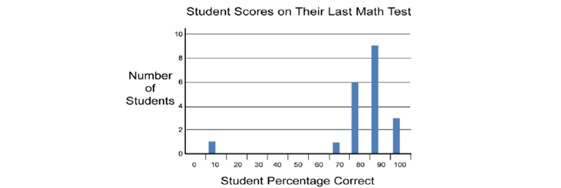
A. The distribution has a gap.
B. There is a peak at 90%.
C. There is an outlier.
D. The median scored by the students is 50.
4. What is the area of this parallelogram?
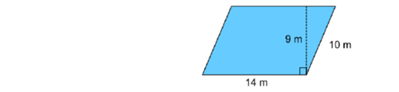
A. 20 m2
B. 126 m
C. 120 m2
D. 126 m2
5. Which option clarifies the vague pronoun reference in the sentence below?
Jackie finally beat Kendall at checkers. She was very proud.
A. Jackie was very proud.
B. The girls were proud.
C. They were proud.
D. Kendall was proud.
6. What kind of sentence is shown below?
Although Tate doesn’t like horror movies, he rented the latest thriller, and will watch it with his friends at the sleepover.
A. simple sentence
B. compound sentence
C. complex sentence
D. compound-complex sentence
7. Which word is spelled correctly?
A. musuem
B. national
C. locasion
D. multaple
Are you ready to start preparing your child for their i-Ready Test for 6th Grade? Are you interested in more i-Ready practice for 6th Grade? We have over 900 i-Ready Diagnostic practice questions for 6th Grade, plus expert tutors, engaging test prep, and more! Try out our 100 Free Questions today!
See if TestingMom.com supports your child’s test by your school district. If you don't see your child's school district listed, check with us! We have practice for other tests as well.
Tell us about your experiences
6 Responses
i love it but i wish it will give us more
Hello,
I’m in 6th grade and i got a 574 on my reading diagnostic. Do you happen to know what grade level that score is? And if I’m in the 6th grade level?
~ Joslyn
I will like to prepare my son and need practice questions.
I-ready Math