
i-Ready 8th Grade Practice Questions & Test Prep
The i-Ready Diagnostic, now called i-Ready Inform™ for Reading and Mathematics, is an adaptive online assessment that helps teachers understand your child’s current Reading and Math skills and determine what they’re ready to learn next.
Because the assessment is adaptive, question difficulty changes based on your child’s responses. When your child demonstrates a strong understanding of a skill, they may receive more challenging questions. If they struggle, the assessment can adjust to gather more information about the skills they’ve mastered and the areas where they may need additional instruction.
This means your eighth grader may encounter questions covering material they haven’t learned yet.
That’s normal.
Students aren’t expected to answer every question correctly. Challenging questions help an adaptive assessment determine the range of skills a student currently understands.
Here are some of the Reading and Mathematics skills an eighth grader may encounter.
Math
Algebra and Algebraic Thinking – Eighth graders work extensively with linear equations, systems of equations, functions, and relationships between quantities. They may solve multi-step linear equations, analyze and graph linear relationships, compare functions represented in different ways, determine slope and interpret equations in real-world situations. These skills are particularly important as students prepare for high school algebra.
Numbers and Operations – Students deepen their understanding of rational and irrational numbers and work with integer exponents, square roots, and scientific notation. They may compare and estimate irrational numbers, apply properties of exponents, perform calculations using scientific notation, and solve problems involving very large or very small quantities.
Geometry – Students analyze transformations, congruence, similarity, and relationships among geometric figures. They may work with rotations, reflections, translations, and dilations; apply the Pythagorean theorem; solve problems involving angles; and find volumes of cylinders, cones, and spheres.
Measurement and Data – Eighth graders analyze patterns and relationships in data, including relationships between two variables. They may interpret scatter plots, examine associations between variables, use lines to model data, analyze two-way tables, and draw conclusions based on data.
Reading
By eighth grade, Reading questions increasingly require students to analyze, interpret, evaluate, and support conclusions with strong textual evidence.
Students need to understand not only what a text says but also how an author develops ideas, constructs an argument, uses language and structure, and influences the reader’s understanding.
Vocabulary – Students determine the meaning of increasingly sophisticated words and phrases in context. Questions may involve Greek and Latin roots, prefixes and suffixes, academic and domain-specific vocabulary, figurative language, connotation, multiple-meaning words, and nuances in word meaning. Students may also analyze how specific word choices contribute to meaning and tone.
Comprehension: Literature – Students read increasingly complex stories, poems, dramas, and other literary texts. They may determine themes, analyze character development, examine how dialogue or events influence the plot, analyze point of view, interpret figurative language, compare elements within or across texts, and determine how an author’s choices contribute to meaning, tone, and structure.
Comprehension: Informational Text – Students read complex nonfiction texts such as articles, essays, biographies, historical passages, and other informational materials. They may determine central ideas, analyze how ideas are developed, evaluate arguments and evidence, determine an author’s purpose or point of view, analyze text structure, distinguish relevant from irrelevant evidence, compare conflicting information or perspectives, and support conclusions with evidence from the text.
Foundational Reading Skills – If a student’s responses indicate that additional information about foundational reading skills is needed, an adaptive assessment may present questions targeting underlying word-reading or decoding skills. This can help identify whether difficulty with complex texts is connected to more fundamental reading skills that need additional support.
What Should My 8th Grader Practice for i-Ready?
By eighth grade, students are preparing for the transition to high school. Strong preparation means being able to apply skills independently, analyze unfamiliar information, and explain the reasoning behind an answer.
For Reading, practice:
- Reading complex fiction and nonfiction
- Determining central ideas and themes
- Making and supporting inferences
- Summarizing objectively
- Analyzing character and idea development
- Analyzing point of view and author’s purpose
- Evaluating arguments and evidence
- Analyzing text structure
- Comparing information and perspectives
- Interpreting figurative language
- Analyzing tone and word choice
- Building academic and domain-specific vocabulary
- Using roots, prefixes and suffixes
- Citing strong textual evidence
For Math, practice:
- Rational and irrational numbers
- Square roots
- Integer exponents
- Scientific notation
- Linear equations
- Systems of equations
- Slope
- Graphing linear relationships
- Functions
- Transformations
- Congruence and similarity
- The Pythagorean theorem
- Volume
- Scatter plots
- Two-way tables
- Bivariate data
Practice the Reasoning Behind the Answer
At this age, students should be able to do more than choose the correct answer. They should be able to explain why it’s correct.
For Reading, ask:
“What evidence supports your answer?”
“What is the author trying to accomplish here?”
“How does that word choice affect the tone?”
“Why is that answer better than the other choices?”
For Math, ask:
“How do you know your answer is reasonable?”
“What information did you need to solve the problem?”
“Can you represent the problem another way?”
“What mistake might lead someone to choose one of the other answers?”
These questions encourage the kind of analytical thinking students will increasingly need in high school.
Why Is My Child Seeing Questions They Haven’t Learned Yet?
Your eighth grader may finish the assessment and say:
“Some of those questions were way harder than anything we’re doing in class.”
That doesn’t automatically mean your child did poorly.
Because the assessment is adaptive, students may encounter increasingly challenging material as the test gathers information about what they know and what they’re ready to learn next.
Before testing, remind your child:
“You aren’t expected to know everything. When you see something unfamiliar, don’t give up right away. Read carefully, use what you do know, eliminate choices that don’t make sense, make your best choice, and keep going.”
Middle school students can also become frustrated when they encounter unfamiliar material because they’re used to knowing how to approach most classroom assignments.
Remind your child that struggling with a difficult question isn’t the same as failing the test.
The goal is to stay focused and keep thinking.
Practice i-Ready-Style Questions
TestingMom’s i-Ready-style practice can help eighth graders strengthen the Reading and Math skills they may encounter and feel more comfortable working through unfamiliar, challenging questions.
Because the assessment is adaptive, good preparation isn’t about predicting or memorizing the exact questions your child will receive.
Instead, practice should help your child strengthen the underlying academic skills, recognize different types of problems, use effective strategies, and develop the confidence to work independently when a question doesn’t look familiar.
For an eighth grader, that’s especially important. They’re not just preparing for one assessment.
They’re building the Reading, math, and problem-solving skills they’ll need when they enter high school.
Below are sample questions representative of the 7th Grade questions your child will see on the test, but they are not taken directly from the i-Ready Diagnostic being administered this year.
Directions: Read the following passage:
The idea that there might be life on Mars isn’t new. In 1996, scientists claimed that a piece of the red planet, which had arrived here as a meteorite, “pointed” to life on Mars. The rock sample contained three possible clues. First, the rock contained magnetite, a crystal form of iron oxide which is the byproduct of certain bacteria. Second, the mix of minerals and carbon compounds was the same as that produced on Earth by certain microbes. Finally, under a powerful microscope, the scientists could see segmented chain-like patterns similar to the shape of some Earth-bound bacteria. Unfortunately, all this evidence could equally be explained by chemical and geological processes, and few scientists now believe the sample is proof of Martian life. Yet it did spark a debate and renew interest in Mars. In the past two decades, evidence has emerged that suggests that in the past, conditions there were much the same as on Earth – but something went wrong. Whereas life on Earth evolved, life on Mars may have begun, and then stopped. Why that happened is the current focus of NASA’s Mars research, and new rock samples are being collected that – in the future – could answer the life-on-Mars question once and for all.
1. The author puts the word “pointed” in quotation marks primarily to:
A. indicate that the evidence was limited.
B. suggest the evidence was open to interpretation.
C. highlight the scientists’ caution about the claim.
D. underscore the doubtful nature of the evidence.
2. The best evidence that life could potentially have existed on Mars is:
A. the existence of magnetite.
B. the particular mix of minerals and carbon compounds.
C. the segmented chain-like patterns indicative of bacteria.
D. the conditions being much like those on Earth.
3. As it is used in the passage, the word “certain” most nearly means:
A. clear.
B. particular.
C. evident.
D. selected.
4. Which answer choice shows the following in scientific notation?
(6.4 x 10¹²) ÷ (3.2 x 10³)
A. 2 x 10¹⁵
B. 2 x 10⁹
C. .2 x 108
D. 2 x 10¹⁰
Look at the table below. It organizes data based on a student’s appearance on the Honor Roll and whether or not they participate in school sports.

5. Of the total number of students, about what percentage plays sports, but are not on the Honor Roll?
A. 16%
B. 14%
C. 10%
D. 12%
6. Which of the following is the new image of point D after a reflection over the x-axis?
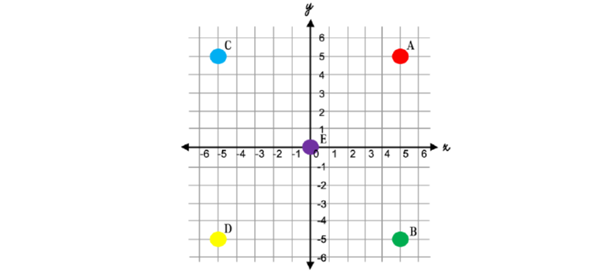
A. Point A
B. Point B
C. Point C
D. Point E
7. Which of the options is the participle phrase of the sentence below?
My unquenchable thirst was not satisfied with the sickly-sweet smoothie that my brother made.
A. My unquenchable thirst
B. was not satisfied
C. sickly-sweet smoothie
D. that my brother made.
8. Which option below does NOT contain a shift in verb tense?
A. Linda ran for twenty minutes until she is reaching the end of the road.
B. When Gabe finishes his painting, he took his paintbrushes into the kitchen and had placed them in the sink.
C. Hilda will play the guitar if you will turn the pages of the music.
D. We are going to the park to saw ducks swimming today.
9. What is the meaning of the suffix ‘-ize’?
A. cause or become
B. together
C. in relation to
D. present participle of action
Are you ready to start preparing your child for their i-Ready Diagnostic for 8th Grade? Would you like more i-Ready Test practice for 8th Grade? We have over 800 i-Ready Diagnostic practice questions for 8th Grade, plus expert tutors, engaging test prep, and more! Try out our 100 Free Questions today!
See if TestingMom.com supports your child’s test by your school district. If you don't see your child's school district listed, check with us! We have practice for other tests as well.
Tell us about your experiences
5 Responses
this app is very well for my child it gives them knowledge for their tests ahead ;):)
form,
Mother
The iready diagnostic needs a lot of improvement (it sucks). Whenever I got a higher level question wrong it would put me down to math 3 grades below me!!!! And it takes 2-3 days to do one diagnostic. The calculator on the math portion is also really bad, because it doesn’t have parentheses, exponents, an answer key, and when you click on multiply or subtract, it goes to another screen and you can’t see what you have typed in so far. Additionally, it gave me a score of 581, which is supposedly in the 30th percentile. I am in a highly gifted magnet and am studying math 2 years ahead of my grade. I feel like the iready diagnostic is not right for me, and it does not give questions right for me even though I am not rushing and reading everything through.
No answer Key 0/10, questions limitied and u need to pay for the “free” trial.
My suggestion Free account
50 questions per day
up to 15 days a month
This is so good and so easy!