
i-Ready 4th Grade Sample Questions
Choose a ProgramThe i-Ready Diagnostic, now called i-Ready Inform™ for Reading and Mathematics, is an adaptive online assessment that helps teachers understand your child’s current Reading and Math skills and determine what they’re ready to learn next.
Because the assessment is adaptive, question difficulty changes based on your child’s responses. When your child demonstrates that they understand a skill, they may receive more challenging questions. If they struggle, the assessment can adjust to better identify the skills they’ve already mastered and the areas where they may need additional instruction.
This means your fourth grader may encounter questions covering material they haven’t learned in school yet.
That’s normal.
Your child isn’t expected to answer every question correctly. Difficult questions help an adaptive assessment determine the range of skills your child currently understands.
Here are some of the Reading and Mathematics skills a fourth grader may encounter.
Math
Algebra and Algebraic Thinking – Fourth graders work with multiplication and division relationships, factors, multiples, patterns, and unknown quantities. They may solve multi-step problems, determine missing values, generate and analyze patterns, and use equations to represent mathematical situations.
Numbers and Operations – Students build their understanding of place value and multi-digit whole numbers while developing greater fluency with addition, subtraction, multiplication, and division. They also work extensively with fractions, including equivalent fractions, comparing fractions, and operations involving fractions. Decimal concepts may also be introduced and connected to fractions and place value.
Geometry – Students identify, classify, and analyze two-dimensional shapes based on their properties. Questions may involve lines, angles, symmetry, parallel and perpendicular lines, and classifying shapes according to their attributes.
Measurement and Data – Students solve measurement problems and interpret information presented in tables, graphs, line plots, and other data displays. Skills may include converting measurements within the same measurement system, solving problems involving time, length, mass, and volume, working with angles, and using data to solve problems.
Reading
By fourth grade, students are expected to do much more than simply understand what happened in a passage. They increasingly need to analyze what they read, make inferences, determine meaning from context, and support their answers with evidence from the text.
Vocabulary – Students demonstrate their understanding of increasingly sophisticated words and how they’re used in context. Questions may require children to use context clues, prefixes, suffixes, roots and word relationships to determine meaning. They may also encounter figurative language and words with multiple meanings.
Comprehension: Literature – Students read literary texts such as stories, poems, and other fiction and demonstrate a deeper understanding of what they’ve read. Skills may include determining a theme or central message, describing characters and their motivations, making inferences, analyzing events and settings, comparing elements of texts, and supporting answers with specific details.
Comprehension: Informational Text – Students read increasingly complex nonfiction and informational texts. They may determine the main idea, identify supporting details, explain relationships among events or concepts, compare information, interpret text features, determine an author’s purpose or point of view, and use evidence from the passage to support an answer.
Phonics and Word-Reading Skills – If a student’s responses indicate a need for additional information about foundational reading skills, the adaptive assessment may include questions involving phonics, decoding, and word recognition. These questions can help identify whether difficulties with more advanced reading tasks are connected to underlying word-reading skills.
High-Frequency Words – Some students may also encounter questions involving frequently used words if the assessment needs additional information about foundational reading development.
What Should My 4th Grader Practice for i-Ready?
For fourth graders, focus preparation on strengthening grade-level Reading and Mathematics skills rather than trying to predict the exact questions your child will receive.
For Reading, practice:
- Reading fiction and nonfiction
- Determining main ideas and supporting details
- Identifying themes
- Making inferences
- Summarizing
- Comparing characters, events, or ideas
- Understanding an author’s purpose and point of view
- Using context clues
- Vocabulary
- Prefixes, suffixes, and roots
- Figurative language
- Finding evidence in a passage to support an answer
For Math, practice:
- Place value
- Multi-digit addition and subtraction
- Multiplication and division
- Factors and multiples
- Fractions and equivalent fractions
- Comparing fractions
- Decimal concepts
- Multi-step word problems
- Measurement and conversions
- Data and graphs
- Angles
- Lines and shapes
- Mathematical patterns
Fourth grade is also a good time to make sure your child can explain how they reached an answer.
Instead of stopping when your child gives you the correct answer, ask:
“How do you know?”
or
“Show me how you figured that out.”
Those simple questions encourage the kind of reasoning children increasingly need as Reading and Math become more complex.
Why Is My Child Seeing Questions They Haven’t Learned Yet?
This is one of the most important things to explain before your child takes i-Ready.
Your fourth grader may encounter a question and immediately say:
“We haven’t learned this!”
That’s okay.
Because the assessment is adaptive, it may continue presenting more challenging material as your child answers questions correctly. The purpose is to determine what your child already understands and what they’re ready to learn next.
Tell your child:
“Some questions may be easy, some may be just right, and some may be really hard. You’re not expected to know everything. Think carefully, choose the best answer you can, and keep going.”
Also remind your child not to judge how they’re doing based on the difficulty of the questions.
A hard question doesn’t necessarily mean they’re doing badly.
An easy question doesn’t necessarily mean they’re doing badly either.
The best strategy is to focus on the question in front of them, work carefully, and keep going.
Practice i-Ready-Style Questions
TestingMom’s i-Ready-style practice can help fourth graders strengthen the Reading and Mathematics skills they may encounter and become more comfortable solving unfamiliar problems.
Because i-Ready is adaptive, practice can’t predict the exact questions your child will receive—and that’s not really the goal.
Good preparation helps your child build the underlying academic skills, practice problem-solving strategies and develop the confidence to keep working when questions become challenging.
You don’t want your child memorizing answers. You want your child knowing what to do when they don’t immediately know the answer.
Below are sample questions representative of the 4th-grade questions your child will see on the test, but they are not taken directly from the i-Ready being administered this year.
Which choice is most nearly the opposite of the underlined word?
The restaurant was very obliging and moved us to a bigger table.
A. forceful
B. compelling
C. difficult
D. unpleasant
Refer to the map below: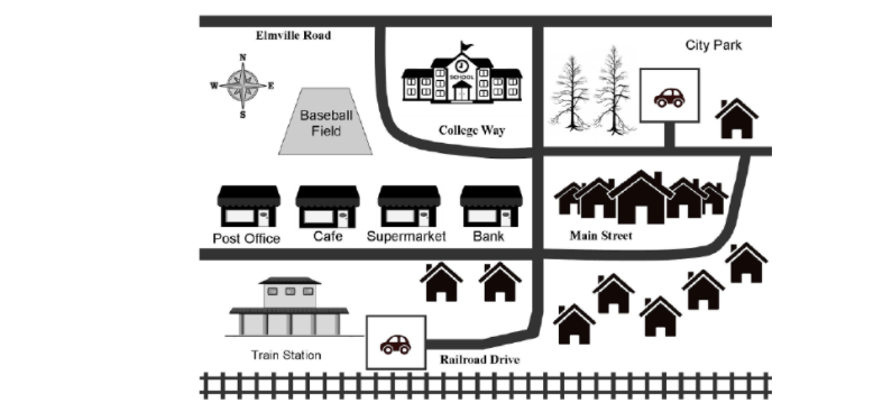
2. Which statement is FALSE?
A. The south-western car park is next to the train station.
B. The northernmost street is Elmville Road.
C. The café is due south of the baseball field.
D. The school is to the east of City Park.
Read the poem:
Silver, black, silver, black,
Chrome and tiles and “mind the gap.”
A rush of air, a burst of light
Strangers’ faces fly from sight.
3. Where is the poem most likely set?
A. A bus station
B. A subway station
C. A railway station
D. A gas station
4. Which number comes next?
92, 105, 118, 131, 144, ____
A. 159
B. 160
C. 157
D. 165
5. Calculate the perimeter and area of the green grid.
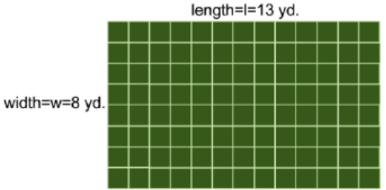
A. Perimeter = 52 yards Area = 42 square yards
B. Perimeter = 42 yards Area = 104 square yards
C. Perimeter = 26 yards Area = 104 square yards
D. Perimeter = 104 yards Area = 42 square yards
6. Solve:
178
X 4
A. 174
B. 182
C. 482
D. 712
7. Fill in the blank with the correct word choice.
_______ dog is barking outside?
A. Who’s
B. Whose
C. Whom
D. Who
8. Choose the sentence that is punctuated correctly.
A. Before I leave the house each day I grab my lunch.
B. The dog ran across the yard, and retrieved the frisbee.
C. I don’t like to watch Hallmark movies but I like Hallmark greeting cards.
D. Our teacher gave us each a pencil before she gave us the test.
9. Which reference material would you use to find how to pronounce a word?
A. dictionary
B. glossary
C. thesaurus
D. encyclopedia
Are you ready to start preparing your child for their i-Ready for 4th Grade? Would you like more i-Ready Inform practice for 4th Grade? We have over 1,000 i-Ready practice questions for 4th Grade, plus expert tutors, engaging test prep, and more! Try out our 100 Free Questions today!
See if TestingMom.com supports your child’s test by your school district. If you don't see your child's school district listed, check with us! We have practice for other tests as well.
Tell us about your experiences
4 Responses
Really good practice test
I wanted to see the whole 100 question without paying
awesome loved it just what I was looking for best thing in world thank you so much