
i-Ready Test 7th Grade Sample Questions
The i-Ready Diagnostic, now called i-Ready Inform™ for Reading and Mathematics, is an adaptive online assessment designed to help teachers understand your child’s current Reading and Math skills and determine what they’re ready to learn next.
Because the assessment is adaptive, the difficulty of the questions changes based on your child’s responses. When your child demonstrates a strong understanding of a skill, they may receive more challenging questions. If they struggle, the assessment can adjust to gather more information about the skills they’ve mastered and the areas where they may need additional instruction.
This means your seventh grader may encounter questions covering material they haven’t learned yet.
That’s normal.
Students aren’t expected to answer every question correctly. Challenging questions are part of how an adaptive assessment determines the range of skills a student currently understands.
Here are some of the Reading and Mathematics skills a seventh grader may encounter.
Math
Algebra and Algebraic Thinking – Seventh graders work with algebraic expressions, equations, inequalities, and relationships between quantities. They may simplify and rewrite expressions, solve multi-step equations and inequalities, represent real-world situations mathematically, and use variables to solve problems. Students also build the reasoning skills they’ll need for more advanced algebra.
Numbers and Operations – Students extend their understanding of rational numbers and learn to perform operations with positive and negative numbers, fractions and decimals. They also work extensively with ratios, rates, proportions, and percentages and apply these concepts to real-world problems involving discounts, markups, tax, tips, percent change, and other situations.
Geometry – Students solve problems involving angles, scale drawings, circles, area, surface area and volume. They may use proportional reasoning with geometric figures, analyze relationships between angles, draw or construct figures that meet given conditions, and solve real-world problems involving two- and three-dimensional shapes.
Measurement and Data – Seventh-grade mathematics places greater emphasis on statistics and probability. Students may analyze samples and populations, compare data sets, interpret graphs and statistical measures, understand variability, calculate probabilities, and use data to make predictions or draw conclusions.
Reading
By seventh grade, Reading questions increasingly require students to analyze how a text works, not simply demonstrate that they understood what they read.
Students may need to make inferences, analyze an author’s choices, compare ideas, evaluate arguments, determine how evidence supports a claim, and support their own conclusions with evidence from the text.
Vocabulary – Students determine the meaning of sophisticated words and phrases using context and word-analysis strategies. Questions may involve Greek and Latin roots, prefixes and suffixes, multiple-meaning words, figurative language, connotation, academic vocabulary and domain-specific terminology. Students may also analyze how an author’s word choice affects meaning or tone.
Comprehension: Literature – Students read increasingly complex stories, poems, dramas, and other literary texts. They may determine themes, analyze how characters and events develop, make inferences, examine point of view, analyze figurative language, interpret an author’s word choice, compare elements of a text, and use textual evidence to support conclusions.
Comprehension: Informational Text – Students read nonfiction texts such as articles, essays, biographies, historical passages, and other informational materials. They may determine central ideas, analyze supporting evidence, examine relationships among ideas, analyze text structure, determine an author’s purpose or point of view, evaluate claims and arguments, and compare how different texts present information.
Foundational Reading Skills – If a student’s responses indicate that additional information about foundational reading skills is needed, an adaptive assessment may present questions targeting underlying word-reading or decoding skills. This can help identify whether difficulty with complex text is connected to a more fundamental reading skill that needs additional support.
What Should My 7th Grader Practice for i-Ready?
By seventh grade, students increasingly need to apply skills, analyze information, and justify their reasoning rather than simply recall rules or facts.
For Reading, practice:
- Reading complex fiction and nonfiction
- Determining central ideas and themes
- Making and supporting inferences
- Summarizing objectively
- Analyzing character and plot development
- Analyzing point of view
- Determining author’s purpose
- Analyzing text structure
- Evaluating claims and evidence
- Comparing ideas across texts
- Understanding figurative language
- Analyzing tone and word choice
- Building academic vocabulary
- Using roots, prefixes and suffixes
- Citing textual evidence
For Math, practice:
- Positive and negative rational numbers
- Fractions and decimals
- Ratios and proportional relationships
- Unit rates
- Percent problems
- Expressions
- Multi-step equations and inequalities
- Real-world algebra problems
- Scale drawings
- Angles
- Circles
- Area, surface area and volume
- Statistics and data
- Samples and populations
- Probability
At This Age, Ask “Why?”
By seventh grade, getting the correct answer is only part of the job.
Students need to understand why an answer makes sense and how they can support it.
When practicing Reading, ask:
“What evidence in the passage proves your answer?”
“Why did the author include that detail?”
“Which answer choice sounds reasonable but isn’t actually supported by the text?”
For Math, try:
“Why did you choose that operation?”
“How do you know your answer is reasonable?”
“Is there another way to solve it?”
“What mistake might someone make on this problem?”
That last question can be especially helpful. Learning to recognize common mistakes can make students much better problem solvers.
Why Is My Child Seeing Questions They Haven’t Learned Yet?
Your seventh grader may finish i-Ready and tell you:
“Some of those questions were impossible!”
That doesn’t automatically mean your child did poorly.
Because the assessment is adaptive, the difficulty can change as the student responds. Your child may encounter material that is unfamiliar or significantly more challenging than what they’re currently studying.
Before testing, remind your child:
“You aren’t expected to know everything. If you see something unfamiliar, don’t give up. Use what you know, eliminate answers that don’t make sense, make your best choice, and move on.”
Middle schoolers also tend to decide very quickly that they “can’t do” a problem when it looks unfamiliar.
Encourage your child to give the problem a chance before deciding it’s too difficult.
Sometimes the most important test-taking skill is simply being willing to stay with a challenging question long enough to figure out what it’s asking.
Practice i-Ready-Style Questions
TestingMom’s i-Ready-style practice can help seventh graders strengthen the Reading and Math skills they may encounter and feel more comfortable working through unfamiliar, challenging questions.
Because the assessment is adaptive, good preparation isn’t about predicting or memorizing the exact questions your child will receive.
It’s about strengthening the underlying academic skills, practicing effective problem-solving strategies, recognizing common question types, and developing the confidence to keep thinking when a problem doesn’t look familiar.
By seventh grade, students need more than the right answer. They need the skills and confidence to figure out how to get there.
Below are sample questions representative of the 7th-grade questions your child will see on the test, but they are not taken directly from the actual i-Ready Test being administered this year.
Directions: Read the following passage.
The common dandelion is an opportunist. It sacrifices body size for reproductive capacity. It saves energy with a hollow stem and has just enough storage capacity to survive the winter. Its leaves are thin and weak, and it pushes its flower just high enough between paving stones or surrounding grass so that, when the big yellow flower turns into the familiar wispy “clock,” the wind can catch and disperse the seeds. Each head has upwards of 40 seeds, sometimes up to 100. When mature, each has its own fine, feathery parachute to help it travel from the parent plant, and a distinctive shape. It has a sharp, pointed end to help the seed easily penetrate the ground it lands on. Dandelions can flower twice in one year—doubling the amount of seeds it can spread in one season and are thus extremely successful—so much so that they live on every continent bar Antarctica.
1. It may be inferred from the passage that dandelions are
A. annuals: growing from seeds each year.
B. perennials: coming up year after year.
C. biannual: growing twice in one year.
D. biennials: growing one year and flowering the next.
2. What is the main purpose of this passage?
A. To describe how dandelions reproduce
B. To explain how dandelions are so successful
C. To highlight how productive dandelions are
D. To describe what a dandelion looks like
3. As it is used in the last line, the word “bar” most nearly means all of the following EXCEPT:
A. save
B. except
C. restrict
D. excluding
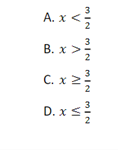
4. Which of the following inequalities represents the inequality shown in the following graph?

5. A spinner is shown in the figure below. If you spin it, what is the probability that the spinner will stop at a green color?

A. 1/12
B. 1/6
C. 1/8
D. 1/5
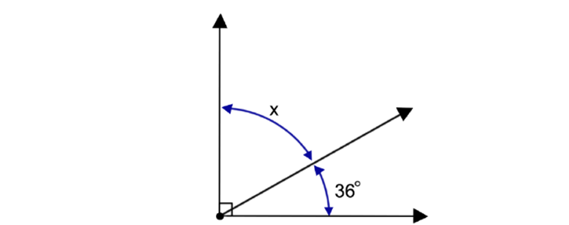
6. Look at the angle below. What is the value of angle x?
A. 36°
B. 48°
C. 54°
D. 64°
7. Identify the prepositional phrase in the following sentence:
The people in the audience cheered loudly when they finished watching Wicked.
A. The people
B. in the audience
C. cheered loudly
D. finished watching
8. Identify the type of error in the sentence below:
Tomorrow is Bonnie’s birthday, so we will eat cupcakes and drank Root Beer.
A. misplaced comma
B. subject-verb agreement
C. verb tense
D. misplaced modified
9. Which option expresses the idea best?
A. The sauce Veronica used on her chicken was spicier than her friends could handle.
B. Veronica’s friends wanted a less spicy sauce used on Veronica’s chicken.
C. Choosing a spicier sauce than her friends could handle, Veronica made her chicken.
D. For her chicken, Veronica chose a sauce that was a spicier sauce than her friends could handle.
Are you ready to start preparing your child for their i-Ready Diagnostic for 7th Grade? Are you interested in more i-Ready Diagnostic practice for 7th Grade? We have over 800 i-Ready Diagnostic practice questions for 7th, plus expert tutors, engaging test prep, and more! Try out our 100 Free Questions today!
See if TestingMom.com supports your child’s test by your school district. If you don't see your child's school district listed, check with us! We have practice for other tests as well.
Tell us about your experiences
2 Responses
Am already a member but when I try to use -https://www.testingmom.com/tests/iready-diagnostic/i-ready-test-practice-and-i-ready-test-scores-by-grade-level/7th/- it prompts me to buy a membership.